Alternative Housing Australia
Buying a Tiny Home on Wheels in Australia: Towing, Registration and What to Ask Your Builder
Updated September 2026 | AHA Research Team
Before you buy a tiny home on wheels, it helps to know three things: how much it will really weigh, what you’ll need to tow it, and what makes it legal on the road. Get these right and moving, registering and insuring your tiny home is far simpler.
Towing and trailer standards are mostly national, so this guide applies wherever you live. Where to live in your tiny home is set by each state and territory, so we cover that in our state guides, linked throughout.
All claims in this guide link to the standards they come from. Always confirm details with your state or territory’s road authority before you buy.
Quick answers
Can I tow it on a normal car licence?
Usually, yes. A car licence covers a tow vehicle up to 4.5 tonnes GVM towing a single trailer, within the vehicle manufacturer’s towing limits. Read more
What’s the largest tiny home I can tow without a permit?
Up to 2.5m wide, 4.3m high, 12.2m long including the drawbar, and 4.5 tonnes when fully loaded. Read more
Can my car tow it?
Only if your vehicle’s towing capacity, tow ball limit and combined mass rating all cover your tiny home’s real loaded weight. Most tiny homes need a large 4WD, ute or light truck. Read more
Does it need to be registered?
Yes. It must be built to national trailer standards, entered on the Register of Approved Vehicles, and registered in your state or territory. Read more
Should I tow it myself?
It depends on your vehicle, experience and the route. Many owners use a specialist transport company for longer moves. Read more
Weight: the number that matters most
Weight decides almost everything else: which vehicle can tow your tiny home, what brakes it needs, and whether it stays in the light trailer category. It’s also where buyers are most often caught out, because a finished, fitted-out home often weighs more than the figure in the brochure.
| Term | What it means |
|---|---|
| Tare | The weight of the empty tiny home as built, with no water, furniture or belongings. |
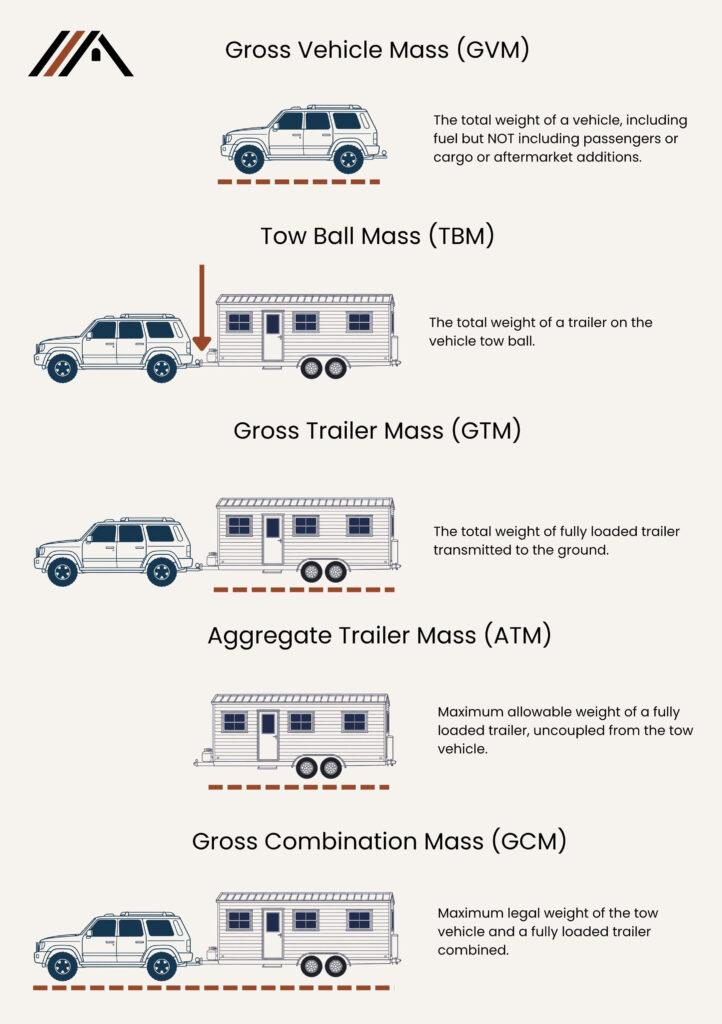
| ATM (Aggregate Trailer Mass) | The maximum the tiny home is rated to weigh when fully loaded and not hitched to a vehicle. This is the key legal limit. |
| Payload | The difference between Tare and ATM: how much you can add in furniture, water and belongings. |
| GTM (Gross Trailer Mass) | The weight carried by the tiny home’s axles when it’s hitched, which is the ATM minus the weight on the tow ball. |
| Tow ball mass | The downward weight the drawbar puts on your vehicle’s tow ball. |
| GVM and GCM | Your tow vehicle’s maximum loaded weight (GVM), and the maximum weight of vehicle and tiny home combined (GCM). |
Tiny homes can be heavy for their size because they’re built like houses, with timber framing, insulation, cladding and full kitchens and bathrooms. Keeping a healthy margin between your tiny home’s real weight and every limit makes towing safer and leaves room for your belongings.
Size limits
Under the national Vehicle Standards Bulletin 1 (VSB1), a tiny home on wheels can be towed without a special permit if it stays within these limits:
| Limit | Maximum | How it’s measured |
|---|---|---|
| Width | 2.5m | Across the body, including wheel guards and awnings, excluding required lamps |
| Height | 4.3m | From the road to the highest point |
| Length | 12.2m | Total length, including the drawbar, coupling and any rear protrusions |
| Weight (ATM) | 4.5 tonnes | Fully loaded, unhitched |
These limits keep trailers within standard lane widths, clear of bridges, tunnels, trees and power lines, and within safe braking limits. Roads and bridges across Australia are built with these dimensions in mind.
Going over the limits
A tiny home wider or taller than these limits needs an oversize permit from your state or territory’s road authority, with signs, flags or lights, and sometimes a pilot vehicle and travel-time restrictions. Signs and pilot vehicles help other drivers see and safely pass a wider load. A tiny home over 4.5 tonnes ATM is a heavy trailer, with stricter design, inspection and registration requirements.
Registration
Every tiny home on wheels must meet the Australian Design Rules and VSB1 before it can be registered. Two national steps come first:
- A Vehicle Identification Number (VIN), which makes the tiny home identifiable.
- Entry on the Register of Approved Vehicles (RAV), which confirms it’s been built to national safety standards. This protects you as a buyer and everyone on the road.
You then register it with your state or territory’s road authority, which may include a safety inspection and a weighbridge ticket.
| State or territory | Register with |
|---|---|
| Queensland | Department of Transport and Main Roads |
| New South Wales | Transport for NSW (Service NSW) |
| Victoria | VicRoads |
| Tasmania | Department of State Growth (Transport Tasmania) |
| South Australia | Department for Infrastructure and Transport |
| Western Australia | Department of Transport |
| ACT | Access Canberra |
| Northern Territory | Motor Vehicle Registry |
Brakes, tow vehicles and licences
Brakes
Brake requirements increase with weight, because heavier trailers can’t be stopped safely by the tow vehicle’s brakes alone.
| Tiny home weight (GTM) | Brakes required |
|---|---|
| Up to 750kg | None required |
| 751kg to 2,000kg | Brakes on both wheels of at least one axle |
| 2,001kg to 4,500kg | Brakes on all wheels, plus an automatic breakaway system |
Almost every tiny home falls into the heaviest category. A breakaway system automatically applies the tiny home’s brakes if it ever comes unhitched. You’ll also need an electric brake controller in your tow vehicle.
Choosing a tow vehicle
Check your vehicle’s compliance plate and owner’s manual for three figures, and make sure your tiny home’s real loaded weight sits comfortably within each:
- Braked towing capacity: the maximum trailer weight the vehicle is rated to tow.
- Tow ball mass limit: the maximum downward weight on the tow ball.
- GCM: the maximum combined weight of vehicle, passengers, cargo and tiny home.
A vehicle rated to tow 3.5 tonnes may not be able to tow a 3.5-tonne tiny home once passengers, fuel and tools are counted against its GCM. Heavier tiny homes often need a light truck.
Licences
A standard car licence covers a tow vehicle with a GVM of up to 4.5 tonnes, towing a single trailer up to 9 tonnes GVM or the vehicle manufacturer’s limit, whichever is less. The licence class is based on your tow vehicle, not the tiny home. If your tow vehicle’s GVM is over 4.5 tonnes, you’ll need a Light Rigid licence or higher.
Check before you buy
Manufacturers are experts in building tiny homes, but where you can live in one depends on your state and your specific land. Before signing anything, check our state guide and get written confirmation from your council or planning authority.
The buying checklist: what to ask your builder
A good builder will be happy to answer these questions and show you the paperwork.
- Is it entered on the Register of Approved Vehicles? Ask for the RAV entry and VIN before you pay a deposit, and check the compliance plate shows the VIN, ATM, GTM and tyre ratings.
- What’s the ATM, and what will the finished home weigh? Ask for a weighbridge ticket for the completed home, or a written estimate of its tare weight with your chosen fit-out. Subtract the tare from the ATM to get your payload, and check that it covers your furniture, water and belongings.
- What are the exact dimensions, including the drawbar? Confirm the total length, width including any awnings, and height on its wheels.
- What brakes and breakaway system are fitted? Check they suit the weight.
- How are water, wastewater and power connected? Flexible, removable connections help the home keep its vehicle status in most states.
- Who handles delivery? Ask whether delivery, permits and pilot vehicles are included in the price.
- What warranty comes with it? Ask what’s covered for the trailer, the structure and the fittings, and for how long.
Moving your tiny home
Towing it yourself or hiring a transporter
Towing a tiny home is different from towing a small caravan. It’s tall, heavy and catches the wind. If you’re new to heavy towing, a towing course is worth considering. For longer moves, or homes near the weight or size limits, many owners use a specialist transport company, which brings the right vehicle, experience and often its own insurance.
Planning the route
- Check for low bridges, overhanging trees and power lines along the way, especially at 4.3m.
- Avoid peak-hour traffic and plan rest stops for long trips.
- Check the weather. High winds are a real risk for tall, flat-sided tiny homes.
- If you need an oversize permit, check whether it limits your route or travel times.
Insurance
Make sure your tiny home is insured while it’s being moved, not just when it’s parked. If you’re using a transport company, ask what their insurance covers.
Getting it onto your site
- Check access: gate width, turning space, slope and ground firmness, especially after rain.
- Look up for power lines and branches along the driveway.
- Choose a level spot with good drainage, and room to reach water and power connections.
Setting up without losing vehicle status
In most states, a tiny home on wheels is treated as a vehicle only while it stays mobile. That usually means keeping the wheels and drawbar on, resting it on stands or jacks rather than permanent footings, and using flexible, removable connections. The rules on how long you can live in it, and where, are set by each state. Check our state guide before setting up.
FAQs
Can I build a tiny home on wheels myself?
Yes, but it must still meet the Australian Design Rules and VSB1, and go through the approval process to get a VIN and be registered.
What should I check when buying second-hand?
Check the registration and compliance plate, get it weighed, and inspect the brakes, tyres, chassis and breakaway system. It’s also worth checking the Personal Property Securities Register (PPSR) to make sure there’s no money owing on it.
Can I import a tiny home?
Imported tiny homes must meet Australian Design Rules and go through the national approval process before they can be registered.
Does my tiny home need a roadworthy?
It depends on your state and its weight. Check with your road authority when you register it.
State and territory guides
Where you can live in your tiny home, and for how long, depends on your state or territory. Find the rules for yours:
| State or territory | Full guide |
|---|---|
| Queensland | Queensland guide |
| New South Wales | NSW guide |
| Victoria | Victoria guide |
| Tasmania | Tasmania guide |
| South Australia | SA guide |
| Western Australia | WA guide |
| ACT | ACT guide |
| Northern Territory | NT guide |
More detail for your project
Why tiny homes are "pig trailers"
VSB1 groups trailers by design. A tiny home with a rigid drawbar and axles near the middle is a “pig trailer”, the same category as most caravans. That’s why the 12.2m total length limit applies.
Weighing your tiny home
A public weighbridge can give you an accurate weight for a small fee. Weigh the tiny home unhitched to check it against the ATM, and hitched to check the tow ball mass and your total combined weight.